
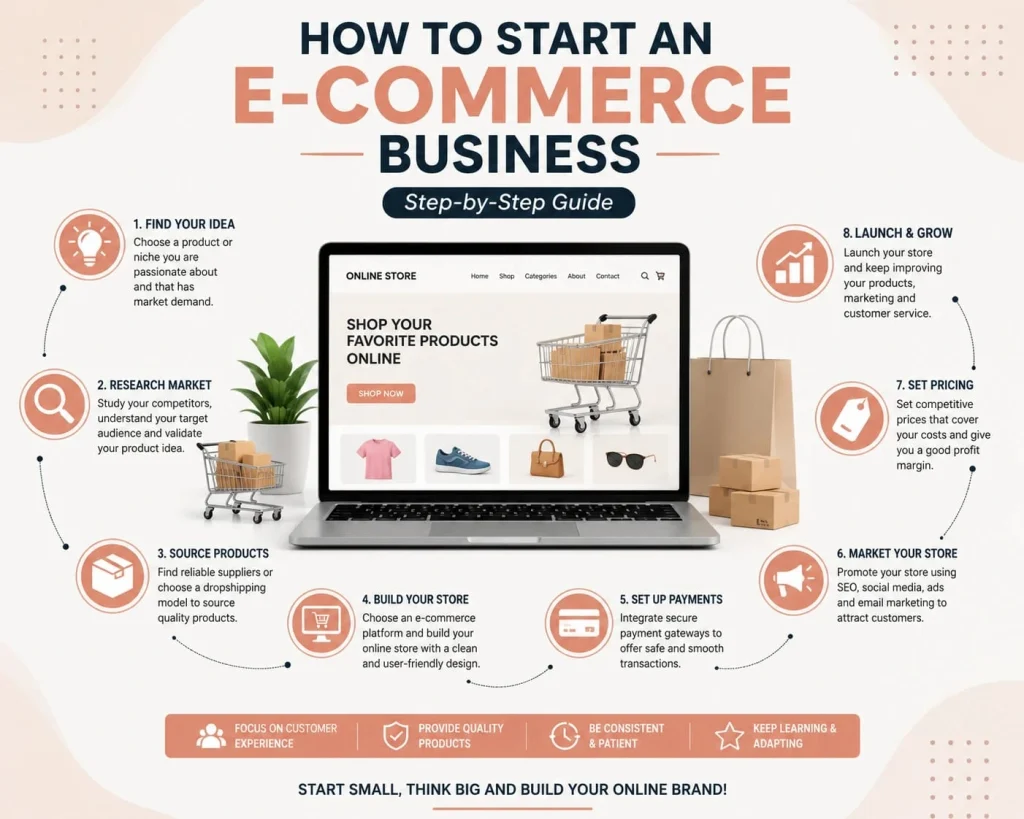
Starting an E-commerce business in India can be a good way to sell products to customers across different cities and states. You do not always need a large physical store to begin. With the right product, a simple business plan, good product presentation, and proper customer service, you can start small and grow step by step. However, it is important to understand the market, legal requirements, website setup, payments, shipping, and marketing before starting.
Choose the Right Product
The first step is deciding what you want to sell. Choose a product that people actually need or want to buy online. You should also check competition, product quality, selling price, and possible profit.
Before choosing a product, check:
- Customer demand
- Competition
- Product cost
- Selling price
- Expected profit
- Shipping cost
- Product size and weight
- Availability from suppliers
A good product should have enough demand and should also allow you to make a reasonable profit.
Research Your Target Customers
Knowing your customers is very important. You should understand who is most likely to buy your products.
For example, ask yourself:
- What age group will buy the product?
- Are they men, women, or both?
- Where do they live?
- What price range do they prefer?
- What problems does the product solve?
- Why would they choose your product?
Customer research can help you create better products, advertisements, and offers.
Study Your Competitors
Before starting an E-commerce business, check other sellers offering similar products. Look at their prices, product photos, descriptions, customer reviews, offers, packaging, and delivery options.
Things to compare:
- Product pricing
- Quality
- Reviews
- Website design
- Social media presence
- Discounts
- Delivery options
- Customer service
Do not simply copy competitors. Instead, find something that can make your store different.
Create a Simple Business Plan
A business plan gives you a clear direction. You do not need a very complicated document in the beginning. Write down your product, target customers, expected expenses, selling price, marketing plan, and growth goals.
Your plan can include:
- Product details
- Target market
- Estimated investment
- Product cost
- Packaging cost
- Shipping cost
- Marketing budget
- Expected sales
- Profit target
A simple plan can help you avoid unnecessary spending.
Decide Your Business Model
There are different ways to run an online store. You can purchase products in advance and keep inventory, manufacture your own products, work with suppliers, or use other models depending on your business.
Common models include:
- Own inventory
- Manufacturing
- Wholesale purchasing
- Dropshipping
- Private labeling
- Handmade products
Choose a model according to your budget, product type, and ability to manage inventory.
Choose a Business Name
Your business name should be simple, memorable, and easy to spell. Try to choose a name that matches your product category and brand image.
Before finalizing the name:
- Check domain availability.
- Check social media usernames.
- Search for similar brand names.
- Consider trademark availability.
- Choose a name customers can remember easily.
A strong brand name can help your E-commerce business look more professional.
Complete the Required Registrations
Depending on your business structure, activities, turnover, products, and selling channels, you may need different registrations or licenses in India. GST requirements can also depend on the nature and scale of your business and where/how you sell.
Possible requirements may include:
- Business registration
- PAN
- Bank account
- GST registration, where applicable
- Other product-specific licenses, where applicable
Because tax and registration rules can change, check the latest requirements on official government portals or speak with a qualified professional before starting.
Open a Business Bank Account
Keeping business and personal finances separate makes accounting easier. A business bank account can help you track sales, expenses, supplier payments, refunds, and other transactions.
Maintain records of:
- Sales
- Purchases
- Advertising expenses
- Shipping expenses
- Returns
- Refunds
- Taxes
- Other business costs
Good financial records are important for long-term growth.
Find Reliable Suppliers
If you are not manufacturing products yourself, you need reliable suppliers. Compare multiple suppliers before making a large order.
Check suppliers for:
- Product quality
- Wholesale price
- Minimum order quantity
- Delivery time
- Packaging
- Return or replacement policy
- Consistency of quality
Order samples first whenever possible. A product may look good in photos but feel very different in real life.
Calculate Your Product Cost
Do not calculate profit by subtracting only the product cost from the selling price. Your real cost can include packaging, shipping, payment charges, advertising, returns, taxes, and other expenses.
A simple calculation is:
Total Cost = Product Cost + Packaging + Shipping + Marketing + Other Applicable Costs
Then compare the total cost with your selling price.
This helps you understand whether your E-commerce business can actually be profitable.
Create Your Brand Identity
Branding helps customers remember your business. Your brand can include a logo, colors, packaging style, product photography, website design, and communication style.
Keep your branding consistent across:
- Website
- Product packaging
- Advertisements
- Emails
- Customer messages
A consistent brand can create a more professional customer experience.
Build Your E-Commerce Website
Your website is your online store. It should be simple, fast, mobile-friendly, and easy to navigate.
Important pages include:
- Home
- Shop
- Product pages
- About Us
- Contact Us
- Shipping Policy
- Return Policy
- Privacy Policy
- Terms and Conditions
Each product page should clearly show the product name, photos, price, available sizes or variations, description, and important information.
Add High-Quality Product Photos
Customers cannot physically touch products online, so photos are extremely important.
Use:
- Clear front photos
- Back photos
- Side photos
- Close-up photos
- Product-in-use photos
- Size or measurement information where useful
For fashion products, showing the product from different angles can help customers make better decisions.
Write Simple Product Descriptions
A product description should explain what the product is, why customers may like it, and important details about its use.
Include:
- Material
- Size
- Color
- Features
- Fit
- Care instructions
- Suitable occasions
Use easy language and avoid making claims that you cannot support.
Set the Right Price
Pricing is one of the most important parts of an E-commerce business. Your price should cover your costs while remaining attractive to your target customers.
Consider:
- Product cost
- Packaging
- Shipping
- Taxes
- Advertising
- Platform charges
- Competitor pricing
- Desired profit
You can also test different offers, such as introductory discounts or bundle pricing, while ensuring the final price remains profitable.
Set Up Online Payments
Customers should have convenient payment options. Depending on your payment provider and business setup, you may offer methods such as cards, UPI, net banking, and other supported options.
Before activating payments, check:
- Transaction charges
- Settlement time
- Refund process
- Supported payment methods
- Security features
A smooth checkout experience can reduce abandoned orders.
Plan Shipping and Delivery
Shipping is a major part of online selling. Choose a delivery partner based on your product, delivery locations, cost, tracking, and service quality.
You should decide:
- Shipping charges
- Delivery areas
- Estimated delivery time
- Tracking process
- Return shipping process
- Packaging requirements
Always communicate realistic delivery times to customers.
Create Safe Packaging
Good packaging protects products and also creates a positive first impression. Your packaging should match the product and be strong enough for transportation.
Packaging can include:
- Protective outer packaging
- Product wrapping
- Brand label
- Invoice where required
- Thank-you card
- Care instructions
Avoid unnecessary packaging costs while making sure the product reaches the customer safely.
Create a Return and Refund Policy
Customers want to know what happens if they receive the wrong, damaged, or unsuitable product. A clear return and refund policy builds trust.
Explain:
- Return period
- Eligible products
- Exchange conditions
- Refund process
- Damaged-product procedure
- Shipping responsibility
Make the policy easy to understand and ensure it complies with applicable Indian laws and rules.
Start Marketing Your Store
After launching your E-commerce business, customers need to know that your store exists. Marketing helps bring visitors to your website and turn them into customers.
You can use:
- YouTube
- Email marketing
- Content marketing
- Influencer collaborations
- Paid advertisements
Start with a small budget and measure results before increasing spending.
Use Social Media
Social media can help you build awareness and connect with customers. For fashion products, photos, videos, styling ideas, and short-form content can be especially useful.
Try posting:
- Product photos
- Reels
- Styling videos
- New arrivals
- Customer reviews
- Behind-the-scenes content
- Offers
- Educational posts
Do not focus only on selling. Useful content can help people remember your brand.
Use SEO
Search engine optimization can help people discover your website through search engines. Create useful pages around topics your customers are searching for.
Focus on:
- Useful keywords
- Clear headings
- Helpful content
- Product descriptions
- Fast website performance
- Mobile-friendly design
- Internal links
- Quality images
SEO usually takes time, so focus on consistent improvement rather than expecting instant results.
Build Customer Trust
Trust is extremely important when customers are buying from a new store. Make your website look professional and provide clear information.
You can build trust through:
- Real product photos
- Clear contact details
- Customer reviews
- Transparent policies
- Secure payment options
- Accurate product descriptions
- Helpful customer support
Never make false claims just to increase sales.
Provide Good Customer Service
Good customer service can turn a first-time buyer into a repeat customer. Respond politely and quickly to questions about products, orders, shipping, exchanges, and returns.
Useful customer service channels can include:
- Phone support
- Website contact form
- Social media messages
Keep communication clear and professional.
Track Your Orders and Inventory
Inventory management becomes important as your E-commerce business grows. You should know which products are selling quickly and which products are not moving.
Track:
- Stock levels
- Sales
- Returns
- Damaged products
- Best-selling items
- Slow-moving items
This information can help you decide what to reorder and what to promote.
Analyze Your Sales
Do not look only at total sales. Understand where your customers are coming from and which products are performing well.
Important numbers include:
- Website visitors
- Orders
- Conversion rate
- Average order value
- Return rate
- Advertising cost
- Customer acquisition cost
- Repeat customers
Regular analysis helps you make better business decisions.
New trends • New arrivals • Exclusive offers
Instagram — @MEOEXFASHION
Facebook — @MEOEXFASHION
Shop Online: MEOEXFASHION.COM
.